
SignalLift reporting methodology
Purpose

High-level explanation of methodology for clients, stakeholders, and non-technical teams.
Key Concepts
Signal vs Hold-out Groups
Traffic is divided into two groups:
SignalLift (Treatment) Group: Users or impressions exposed to PPID/PPS signals
Hold-Out Group: Users or impressions not exposed to signals
Comparison between these groups isolates the incremental effect of the signal, and negates non relevant factors.
Core Metrics
eCPM (Yield per Opportunity): Revenue per opportunity, capturing both CPM changes and fill-rate improvements
Uplift (%): Relative increase in eCPM between the signal-lift and hold-out groups
Denominator Logic: Sum of TOTAL_IMPRESSIONS, UNFILLED_IMPRESSIONS, and AD_SERVER_IMPRESSIONS ensures we account for all monetisation opportunities, not just served impressions
Deterministic Measurement
SignalLift leverages key-value filters in GAM to ensure accurate segmentation.
All calculations are auditable and repeatable, supporting transparency and client trust.
Commercial Relevance
Provides clear visibility into incremental revenue attributable to PPID/PPS signals
Helps clients understand the return on investment from adopting or enabling signals
Supports portfolio-level decision making, including which signals, channels, inventory types are most responsive
Visual Representation
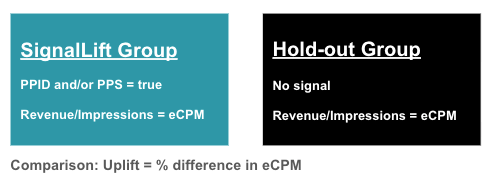
Anonymised SignalLift
Methodology Notes / FAQs
Why we do not recommend relying solely on Google’s PPID Impact estimate | |
|---|---|
Albeit we follow Google's approach, this measurement methodology has some key differences and advantages: | |
No pollution | Google calculates the Yield differential between impressions with and without PPID. When multiple PPIDs run across a network of publishers, it is impossible to isolate the impact of any single PPID which leads to inaccurate results Our measurement methodology allows us to isolate each signal in the reporting and calculate its impact. |
PPS measurement | Google's Impact estimate feature is in BETA and it only measures the impact of PPID, but not of PPS. SignalLift measurement methodology is equally applicable to PPID and PPS, allowing to break down each signals' contribution to lift. |
Verifiability | Google's Impact Estimate do not provide raw data and cannot be independently verified by the publisher. By contrast this our measurement methodology enables publishers to independently verify the yield uplift of PPID and PPS in GAM. |
Progressive roll out | Google doesn't enable publishers to test PPID on a portion of their inventory, because it considers uplift at the network ID level, i.e. across the entirety of a publisher's network. This can falsify results if initial tests are undertaken on selected domains. Or when a second PPID value is running on the same network ID. Anonymised SignalLift can be rolled out and its impact measured on only selected inventory, allowing for accurate test results and an isolated and progressive roll out of the feature. |